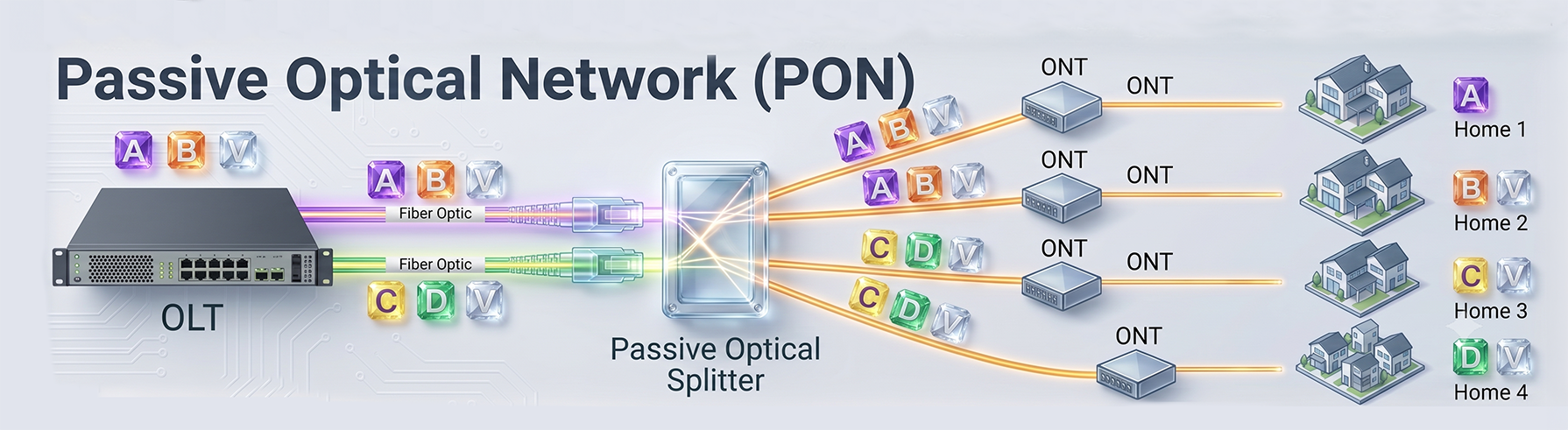



Comprehensive Analysis of PON Architecture, Working Principles, and Technical Evolution
2026-08-24
In FTTH (Fiber to the Home) architecture, PON (Passive Optical Network) is currently the most widely deployed and highly efficient optical transmission technology. Utilizing a Point-to-Multipoint (P2MP) topology, telecom operators can deliver high-speed broadband access to vast user bases while minimizing equipment and operational costs.
1. What is PON (Passive Optical Network)?
PON is a Point-to-Multipoint (P2MP) optical access architecture characterized by:
• Passive Splitting: The transmission path incorporates passive optical splitters without requiring any active electronic components or external power supplies along the link.
• High Reliability & Low Cost: Substantially saves power expenditure and central office footprint, resulting in an exceptionally low failure rate.
• Flexible Splitting Ratios: Supports splitting ratios such as 1:32 and 1:64, allowing a single feeder optical fiber to serve dozens of subscribers.
2. Core Components of a PON System
A standard PON system comprises three major functional modules:
• OLT (Optical Line Terminal): The central office core device responsible for dynamic bandwidth allocation and managing the entire PON domain.
• Passive Optical Splitter: Purely passive optical component that splits a single optical signal to distribute it among multiple users.
• ONU / ONT (Optical Network Unit / Terminal): Customer premises equipment (CPE) that receives optical signals and converts them into residential electrical/Ethernet signals.
3. Operational Principles of Upstream & Downstream Transmission
In a single-fiber bi-directional PON system, downstream and upstream data are transmitted using different optical wavelengths with distinct multiplexing mechanisms:
■ Downstream Transmission
• Operates in Broadcast Mode.
• The OLT transmits data for all subscribers simultaneously. After passing through the splitter, all ONUs receive the exact same data frames.
• Each ONU utilizes hardware address filtering and encryption mechanisms to read only its designated payload, ensuring robust data security.
■ Upstream Transmission
• Utilizes TDMA (Time Division Multiple Access).
• Because multiple ONUs share the same feeder fiber to return data, the OLT dynamically schedules and allocates dedicated Time Slots to each ONU, preventing signal collisions at the optical convergence point.
• 4. Technical Evolution Timeline of PON
| Technology | Downstream Rate | Upstream Rate | Key Applications & Characteristics |
|---|---|---|---|
| GPON | 2.5Gbps | 1.5Gbps | Currently the most widespread 1G-class mainstream FTTH standard. |
| XG-PON | 10Gbps | 2.5Gbps | Asymmetrical 10G PON upgrade solution. |
| XGS-PON | 10Gbps | 10Gbps | Symmetrical 10G PON; the preferred choice for high-speed broadband today. |
| NG-PON2 | 40Gbps | 40Gbps | Adopts TWDM multi-wavelength technology, tailored for enterprise-grade access. |
| 25G / 50G PON | 25/50Gbps | Depends on the standard | Next-gen ultra-high-speed PON, catering to 5G fronthaul/backhaul and Industrial IoT. |