

Confronting Extreme High Density: What is Bend-Insensitive Fiber?
2026-07-27
Driven by the comprehensive data center upgrades to 800G/1.6T and CPO (Co-Packaged Optics), optical cabling and routing are moving toward extreme miniaturization and ultra-high density. When massive amounts of optical fibers are squeezed into extremely confined spaces (such as inside chassis enclosures or behind BTW panels) or within high-density cables, the fibers face severe physical stress. To achieve compact routing without sacrificing signal quality, "Bend-Insensitive Fiber" (BIF) has become a critical material for next-generation networks.
■ Core Specifications and International Standards of Bend-Insensitive Fiber (BIF)
The performance evaluation of Bend-Insensitive Single-Mode Fiber (BI-SMF) is primarily based on the International Telecommunication Union's ITU-T G.657 standard. Compared to standard single-mode fiber (G.652.D), the core specifications of bend-insensitive fiber focus on "attenuation performance under extremely small bending radii" and "compatibility of geometric structures."
■ Why is This Specification Critical for CPO and High-Density Connectors?
In high-density cabling and connector solutions, introducing optical fibers that comply with G.657.A2/B3 specifications brings two major benefits:
1. Perfect Pairing with Easy Push-Pull and BTW (Behind-The-Wall) Connectors:
When patch cords are tightly bundled behind panels or subjected to pulling and squeezing forces during push-pull operations, this specification ensures that the system's Insertion Loss (IL) does not spike.
2. Ideal Suitability for Narrow-Pitch Fiber Arrays:
When drawing out fibers from the chip-end, bend-insensitive fiber can withstand the micro-stresses encountered during packaging encapsulation and bonding. This serves as the specification cornerstone for achieving ultra-low-loss (<0.25dB) packaging quality.
■ Classification of Bend-Insensitive Fiber
Bend-insensitive fibers are primarily divided into two main categories, A and B, which are strictly distinguished by their allowable Bending Radius:
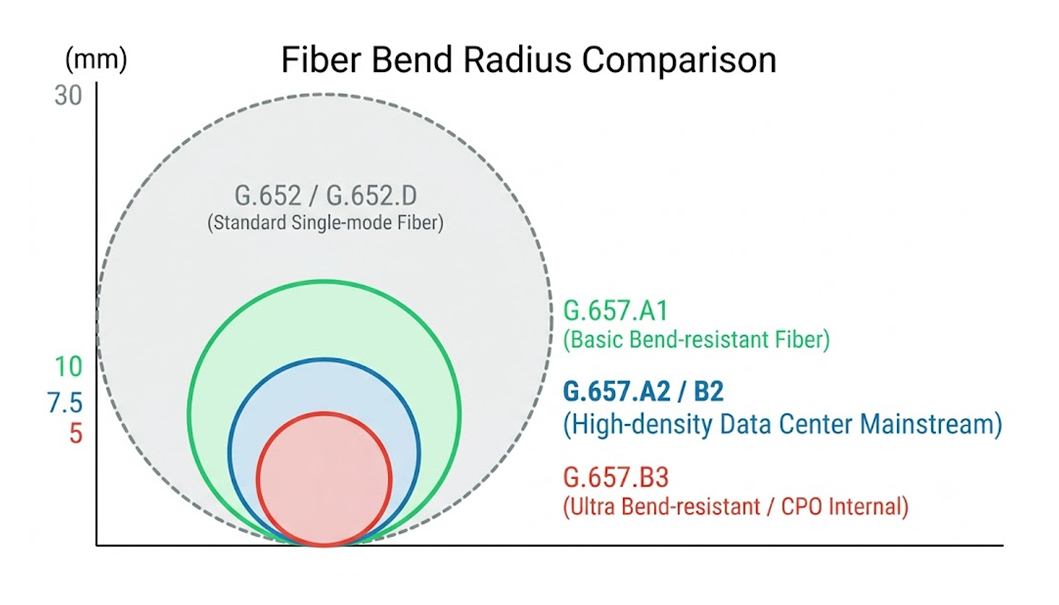
• G.657.A1 (Minimum Bending Radius: 10 mm)
Belongs to the entry-level bend-insensitive category, with a bend tolerance 3 times that of traditional optical fibers. While maintaining high transmission quality, it is primarily applied in compact routing environments such as standard indoor wall runs and corners.
• G.657.A2 (Minimum Bending Radius: 7.5 mm)
The mainstream specified standard for high-density data centers and AI computing clusters. Its bend tolerance is 4 times that of traditional fibers, and it is 100% backward compatible/interoperable with existing G.652.D networks, making it the premier choice for overcoming space bottlenecks in massive cabling and behind-the-wall (BTW) applications.
• G.657.B3 (Minimum Bending Radius: 5 mm)
The highest specification featuring extreme bend-insensitive capabilities, designed specifically for ultra-confined spaces. It can endure extremely sharp-angle bends and severe physical compression, making it an indispensable, critical material for the internal architectures of next-generation CPO (Co-Packaged Optics) chips and ultra-narrow pitch packaging.