


What is MPO?
2026-06-26
MPO (Multi-Fiber Push-On) is a multi-fiber connector standard defined by IEC-61754-7. Unlike traditional single-fiber connectors (such as LC or SC), a single MPO connector can accommodate 12, 24, or even more than 72 fibers. In CPO (Co-Packaged Optics) and hyperscale data center architectures, MPO is the physical interface standard for achieving high-speed data exchange (e.g., 400G, 800G, and 1.6T), significantly reducing space requirements and simplifying cabling complexity.
The Role and Application of MPO in High-Speed Transmission
With the evolution of CPO technology, the MPO connector has become the critical interface bridging the internal Fiber Array (FA) with external networks. Leveraging its ability to support 8-lane (SR4) or 16-lane (SR8) parallel transmission in a single interface, MPO seamlessly interfaces with 400G, 800G, and even 1.6T high-speed transmission protocols. In space-constrained CPO modules, MPO saves more than 75% of panel space compared to traditional LC connectors, drastically increasing bandwidth density. Currently, MPO is widely used for backbone networks and server rack interconnects in hyperscale data centers, as well as the physical interface for CPO optical engines and external patch panels. It is an indispensable core connectivity technology for next-generation high-performance computing and AI clusters.
MT Ferrule: The Performance Core
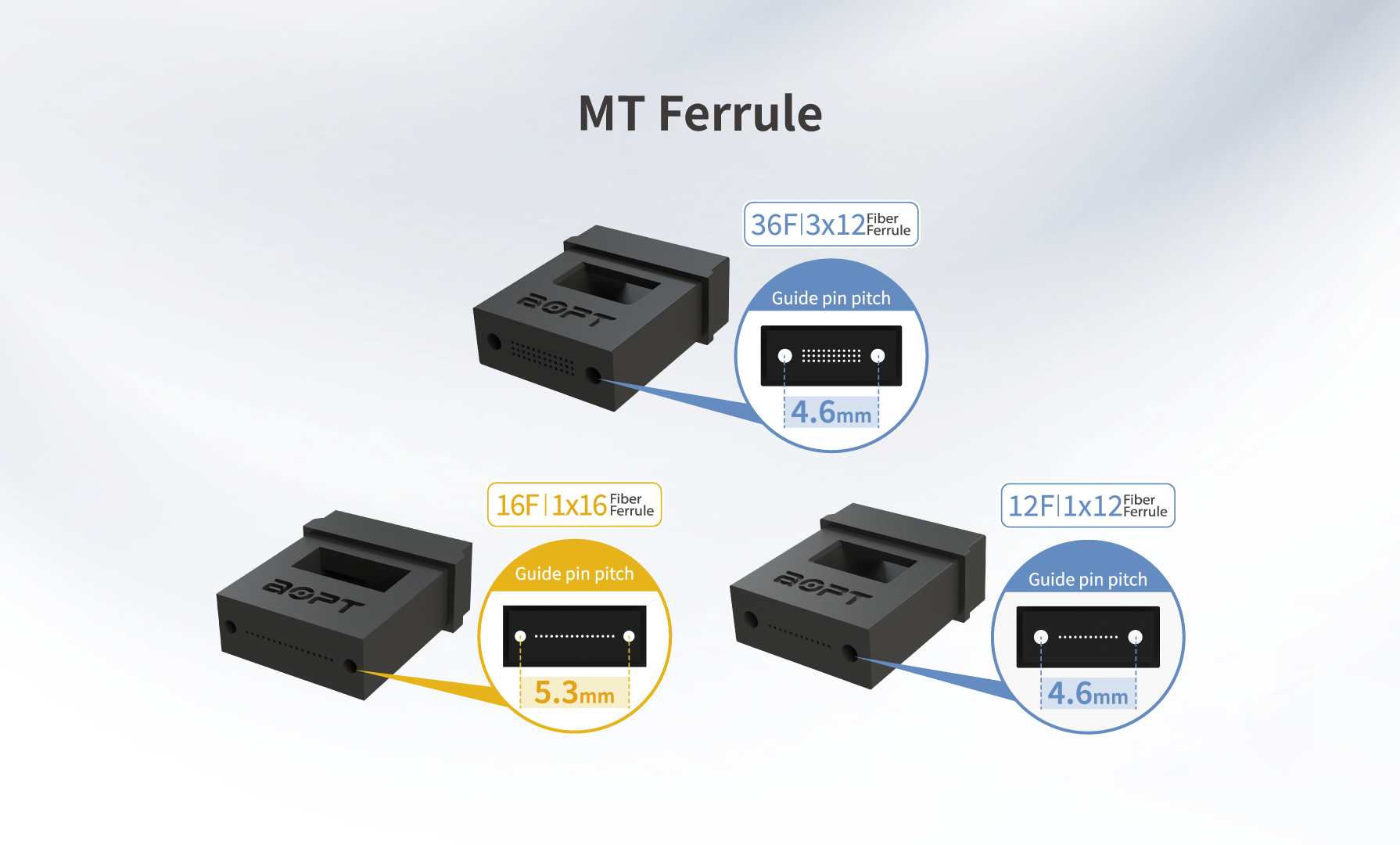
The performance core of the MPO connector lies in its internal MT (Mechanical Transfer) Ferrule:
• High Alignment Precision: Utilizes the coordination of two Pin holes and Guide pins to ensure sub-micron precision for multi-fiber alignment during mating.
• High-Density Arrangement: The MT ferrule enables precise alignment of fibers in rows of 12 or 16, and can achieve higher density connections through multi-layer stacking.
MPO vs. MTP
• MPO is the generic technical standard.
• MTP® is a registered brand by US Conec, featuring the same interface as MPO but with enhanced mechanical and optical performance.