

Why Optical Cabling is Moving Toward High-Density Connector Solutions
2026-05-31
As network architectures accelerate to 800G and 1.6T, data centers and AI computing clusters face an unprecedented bandwidth crunch. In this landscape, migrating optical cabling toward High-Density (HD) connector solutions has become an architectural necessity.
1. Supporting Parallel Optics Channels
Modern 800G and 1.6T protocols rely heavily on Parallel Optics. A single high-speed transceiver now requires 12, 16, or 36fibers simultaneously. High-density connectors (such as MPO-16, Base-8/Base-12) bundle these massive channel counts into a single interface, aligning perfectly with next-gen transmission standards.
2. Maximizing Patch Panel Real Estate
Data center floor space and rack space (U-space) are premium commodities. High-density solutions compress connector form factors, boosting fiber density to 144, or even 288 fibers within a single 1U patch panel area. This drastically increases port density and optimizes the return on investment (ROI) for critical infrastructure.
3. Crucial for High-Density Operations: Easy Push-Pull Technology
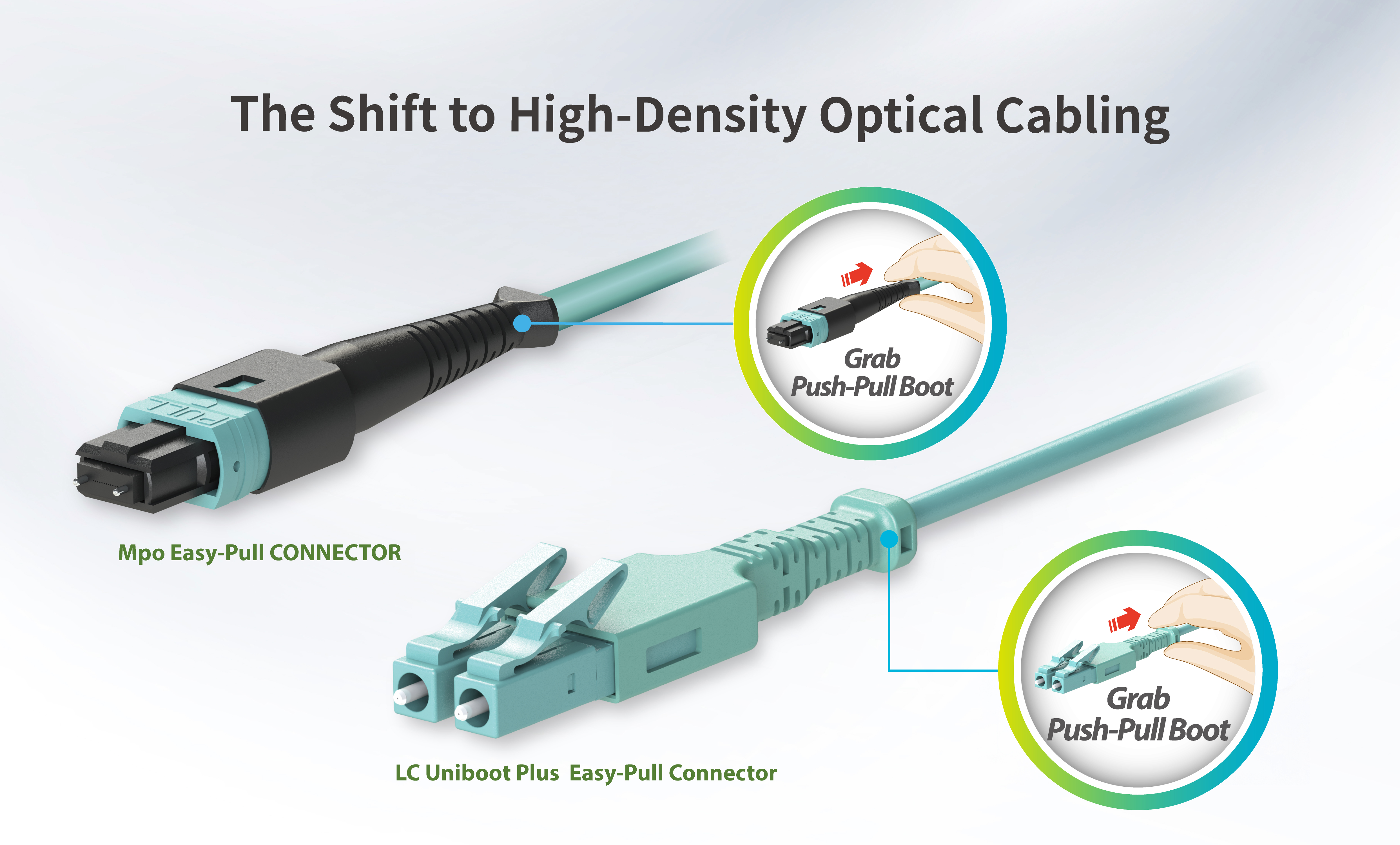
When a patch panel is packed with hundreds of high-density connectors, traditional latch-release mechanisms become unreachable for human fingers. To overcome this, high-density cabling integrates the Easy Push-Pull connector design. Utilizing an extended Push-Pull Tab, technicians can easily plug and unplug individual connectors in ultra-congested environments. This avoids disturbing adjacent live patches, significantly improving maintenance safety and efficiency.